
- This event has passed.
Hallgeir Sirevaag
Detrital zircon inventory of the Triassic Greater Barents Sea Basin: sediment transport and geodynamics
Hallgeir Sirevaag, Christian Haug Eide, Albina Gilmullina, Leif-Erik Rydland Pedersen
The intra-cratonic Greater Barents Sea Basin (GBSB) represents one of the last underexplored petroleum provinces in the world. It is believed to contain most of the yet-to-find hydrocarbon resources on the Norwegian continental shelf, and significant resources are also present within the Russian sector of the Barents Sea (e.g. Shtokman discovery). Several of the hydrocarbon reservoirs within the Barents Sea are of Triassic age (e.g. Goliat field). The reservoir properties are influenced by the mineralogical composition, and the reservoir quality is therefore also strongly linked to the source area for the sediment. Within the GBSB, c. 2200 previously published U-Pb detrital zircon ages from 26 Triassic samples have provided information on the provenance for the Triassic reservoirs. These analyses indicate two main sources for the Triassic succession in GBSB: a south-southwestern source related to the Fennoscandian Shield and the Caledonides contributes with mature sediments with favorable reservoir qualities, while an eastern source from the Urals and the Siberian Traps provided immature sediments with poor reservoir properties. Using U-Pb analyses on detrital zircons for pin-pointing the source area and understanding their geodynamic evolution is therefore useful for predicting the reservoir quality.
Decades of hydrocarbon exploration in the GBSB have made it possible to obtain detrital zircon data from time-equivalent formations over large areas. The GBSB is therefore an ideal basin for a large-scale source-to-sink study of an intra-cratonic basin. Within the ISBAR-project at UiB, we aim to combine previously published U-Pb data with new U-Pb analyses on stratigraphic intervals and geographic areas with low sampling density. This will be done in order to obtain a holistic view of the Greater Barents Sea Basin throughout the Triassic, with respect to temporal and spatial variations in sediment influx. These data can provide information on the relative contribution from the different sediment sources in the basin, and furthermore, and can be used for gaining insight into the geodynamic evolution of the source areas.
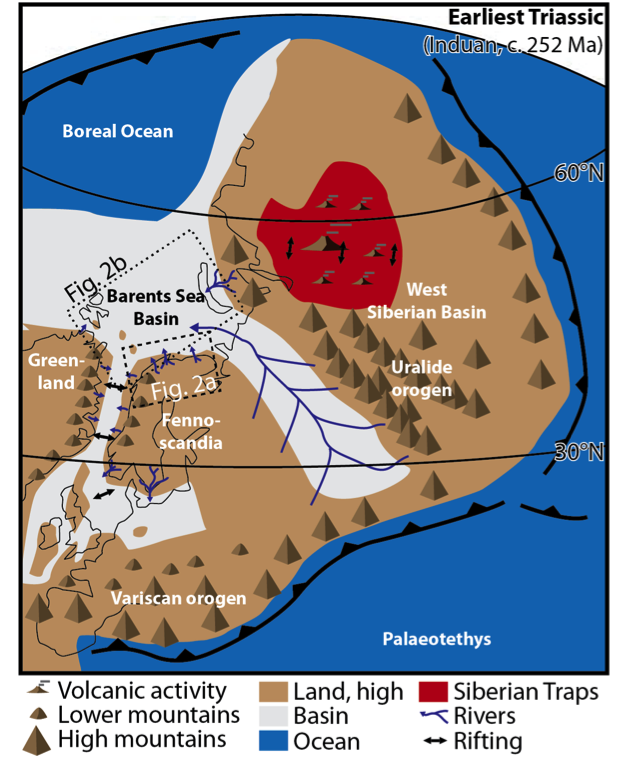
From Eide et al. (2018)